
- Home
- Case Study
Case Study
Waterjet Looms – Mono Yarn Application
In a recent installation of AAS S Flat Healds on waterjet looms running mono yarn, a
significant reduction in beam completion time was recorded.
● Earlier beam life cycle: 45 days
● After installing AAS S Flat Healds: 33 days
This reduction of 12 days per beam directly translates into the ability to run approximately
three additional beams within the same time window. As a result:
● Effective loom utilization increased
● Net fabric output increased without adding machines
● Warp breakage was reduced to zero, as confirmed by loom owners
Such uninterrupted running has enabled customers to convert saved time into additional
production cycles, resulting in tangible productivity expansion.
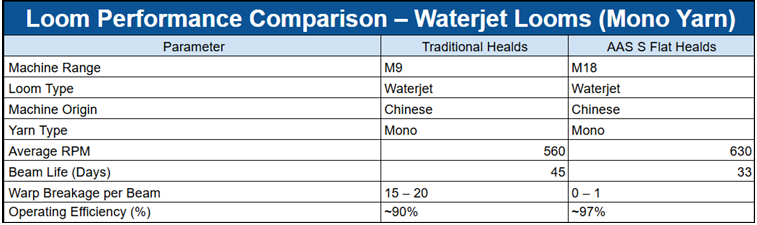
This data proves that AAS S Flat Healds convert stability into speed, and speed into
sustained productivity—without requiring any capital upgrade to the loom.
By reducing beam cycle time, eliminating warp breakage, and increasing operating efficiency
from ~90% to ~99%, AAS S Flat Healds enable weavers to generate additional production
from the same machines, effectively increasing output capacity without increasing labour,
energy, or capital expenditure.
Airjet Looms – High-Speed Performance
In an airjet installation covering 36 machines, AAS healds enabled stable operation close to
930 RPM, while comparable machines using conventional healds were restricted to the
600–700 RPM range.
● The AAS-equipped machines achieved the highest recorded production output
● If extended across all 36 machines, the customer would effectively obtain output
equivalent to 40 machines
This demonstrates how AAS healds directly increase production density per loom by safely
pushing operating speeds beyond conventional limits.
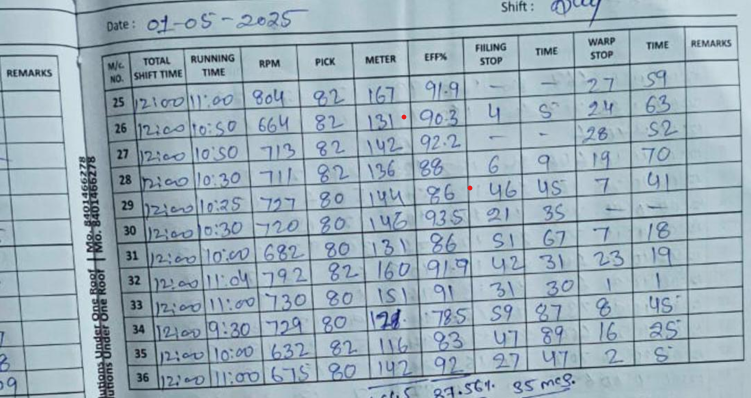
Operation data of other airjet machines
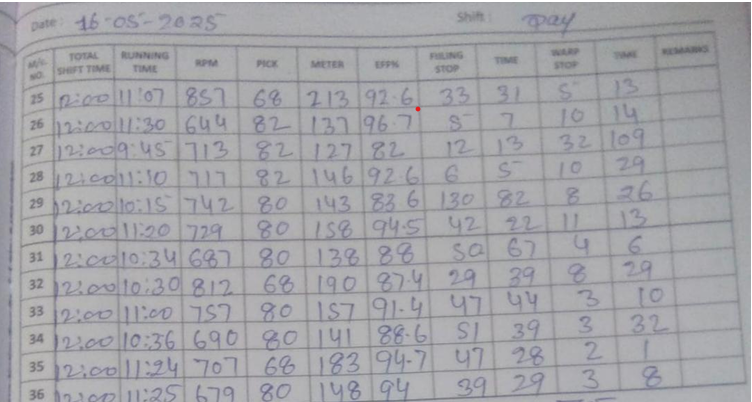
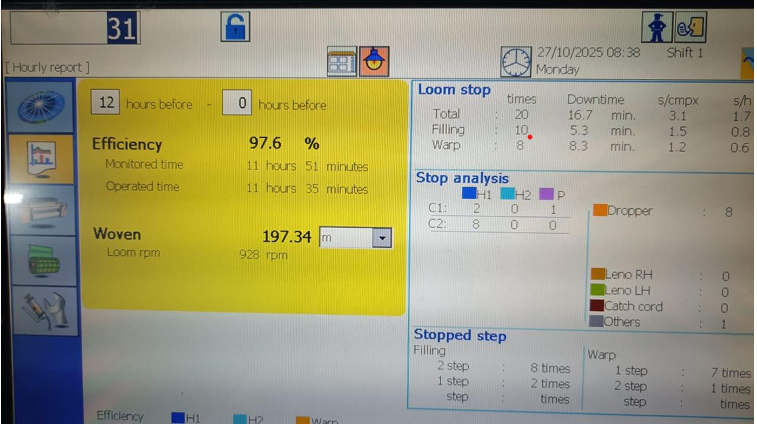
Data of machines with AAS flat healds
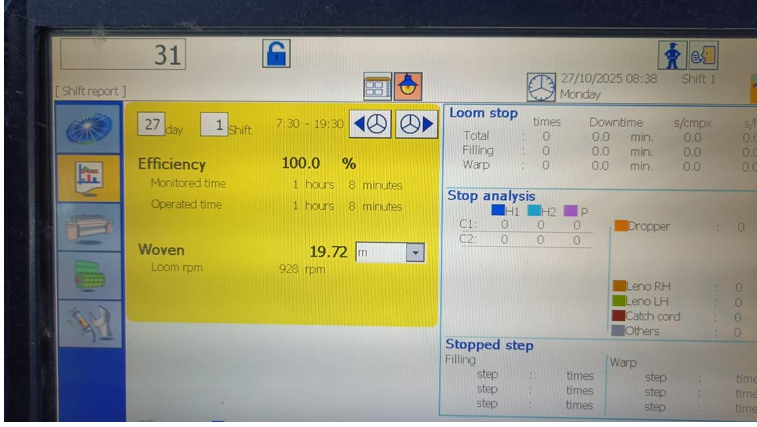
The production reports and monitor screenshots clearly validate the performance advantage
of AAS healds. Machine No. 25 consistently operates at 800–850 RPM under normal
production conditions, while peak operation reaches 928 RPM. This demonstrates that AAS
healds enable higher, stable speeds beyond conventional limits, directly translating into
increased production output per loom. When applied across multiple machines, this
improvement significantly enhances overall production density, confirming the value of AAS technology in maximizing efficiency and throughput.
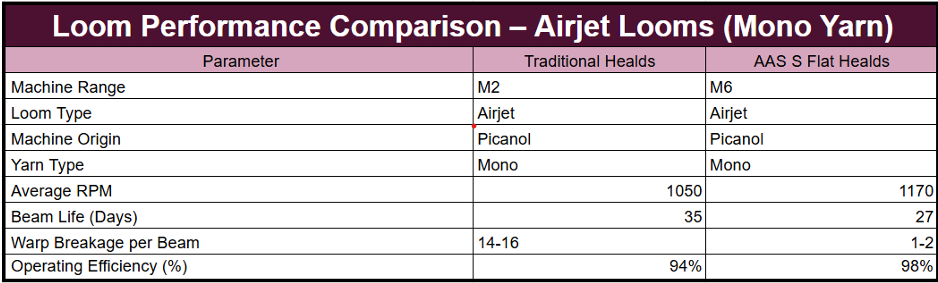
Field Performance Validation – Coimbatore (Ultra High-Speed S Flat Healds)
The above performance comparison represents a controlled field trial conducted in
Coimbatore on airjet looms running mono yarn, using Ultra High-Speed AAS S Flat
Healds under regular production conditions. The machines, yarn type, and operating
environment were kept constant to ensure a like-to-like comparison.
With traditional healds, the loom operated at an average speed of 1050 RPM, achieving a
beam life of approximately 35 days, accompanied by 14–16 warp breakages per beam and
an operating efficiency of 94%. After installing AAS Ultra High-Speed S Flat Healds, the same
loom consistently ran at 1170 RPM, while beam life reduced to 27 days due to significantly
higher production output. Warp breakage dropped sharply to 1–2 breaks per beam, and
operating efficiency improved to 98%, despite the higher running speed.
The reduction in beam life is not a limitation but a direct indicator of higher loom productivity,
as the yarn is consumed faster due to increased RPM and near-zero stoppages.
Annual Beam Throughput Comparison
● Traditional Healds
Beam life: 35 days
Beams per year ≈ 365 ÷ 35 = 10.4 beams/year
● AAS Ultra High-Speed S Flat Healds
Beam life: 27 days
Beams per year ≈ 365 ÷ 27 = 13.5 beams/year
Net Impact
By adopting AAS Ultra High-Speed S Flat Healds, the same loom runs approximately 3
additional beams per year, with higher RPM, dramatically reduced warp breakage, and
superior operating efficiency. This translates directly into higher annual fabric output, lower
labour intervention, reduced downtime, and improved cost efficiency, achieved without
any machine modification or capital expenditure.
Rapier Jacquard Looms – Performance Beyond Machine Rating
In a recent deployment across 18 RIFA 50 rapier Jacquard looms, which are traditionally
operated at 300–310 RPM, AAS healds demonstrated a significant improvement in
operational efficiency. Generally these machines at this RPM produce approximately.
3,80,000 to 4,00,000 picks. With the implementation of our advanced healds, these
machines were able to run stably at 225 to 330 RPM, representing a notable increase in
operational speed without compromising machine stability or fabric quality.
For context, European looms of similar capacity typically operate at around 350 RPM,
generating approximately 450,000 picks per average 12 hour shift. Achieving such
performance on non-European machines has historically been difficult due to limitations in
loom mechanics, warp control, and heald reliability.
With the introduction of AAS healds, average of 18 machines consistently reached
~445,000 picks, effectively matching the output of higher-end European looms, with peak
performance crossing 4,60,000 picks. This means that the customer was able to achieve
the production equivalent of 22 standard machines while operating only 18, creating a
significant increase in overall production efficiency and cost-effectiveness.
Beyond sheer speed, warp breakage—a common source of downtime and fabric
defects—was significantly reduced. This reduction translated into tangible output gains,
with each machine producing approximately three additional sarees per shift, directly
increasing saleable fabric and revenue.
The combination of increased RPM, stable operation, and reduced waste illustrates a
breakthrough in productivity for looms that were previously considered mechanically limited.
This deployment demonstrates that with AAS healds and proper supervision, non-European
looms can achieve near-European output levels, without the need for expensive machine
additions or extensive retrofitting.
This performance enhancement is not merely incremental—it represents a step-change in
loom optimization, combining speed, stability, and yield improvement in one solution. It
validates AAS healds as a reliable and cost-effective upgrade, enabling textile
manufacturers to maximize output and reduce operational losses.
Moreover, the improved fabric quality and reduced downtime ensure consistent
production standards, which is critical in high-volume textile operations where defects or
machine stoppages can result in substantial losses.
In essence, the deployment shows that AAS healds not only increase machine speed and
efficiency but also amplify the effective productivity per loom, creating measurable
financial benefits for the customer
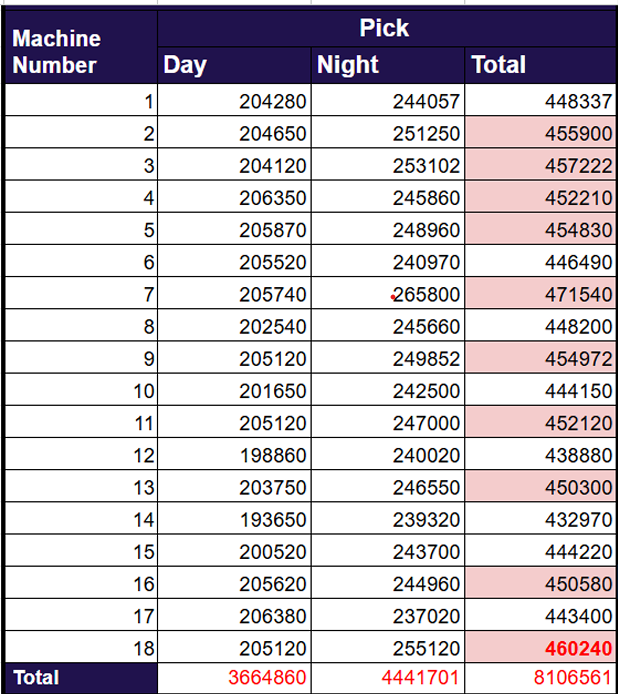
The production data from the 18 RIFA 50 rapier Jacquard looms confirms the transformative impact of AAS healds. Machines traditionally limited to 300–310 RPM consistently ran at 330
RPM, achieving an average of 444,000 picks per loom in a complex satin weave with over
29,000 heald wires. Cumulatively, the 18 machines delivered ~80 lakh picks, equivalent to the
output of 22 standard machines. Reduced warp breakage further added three extra sarees
per machine, directly increasing saleable output. This demonstrates that AAS healds not only
push looms beyond their conventional limits but also enhance overall production efficiency
and profitability, representing a significant breakthrough in loom productivity optimization.
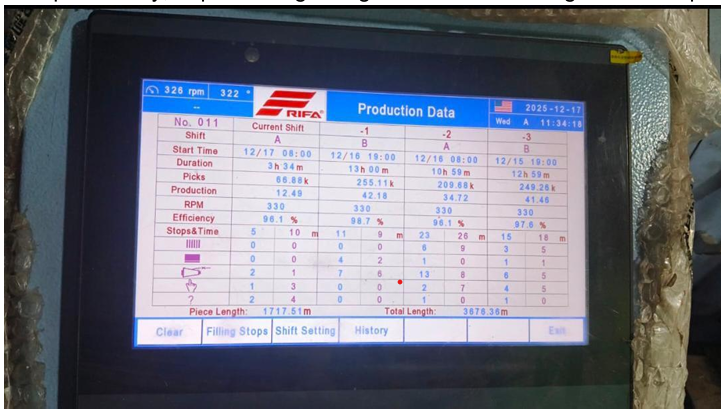
Celebrating excellence in performance! Our top-performing looms and operators are
recognized for achieving uninterrupted production — 16 hours and 34 minutes with zero
warp breakage. AAS healds ensure not just speed, but consistency and quality, empowering
every operator to deliver their best.
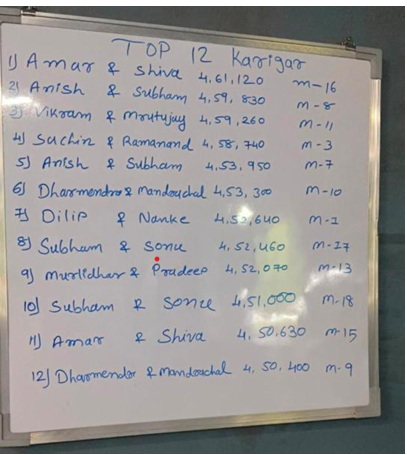
These 12 skilled individuals achieved over 450,000 picks, setting a benchmark in
productivity. With AAS healds, their expertise shines through — delivering exceptional output
with precision and consistency.
Ultra-High Productivity Validation – Airjet Jacquard Application
AAS Tech’s advanced heald systems have demonstrated exceptional performance in airjet
Jacquard weaving on Toyota airjet looms equipped with Staubli Jacquard, under full
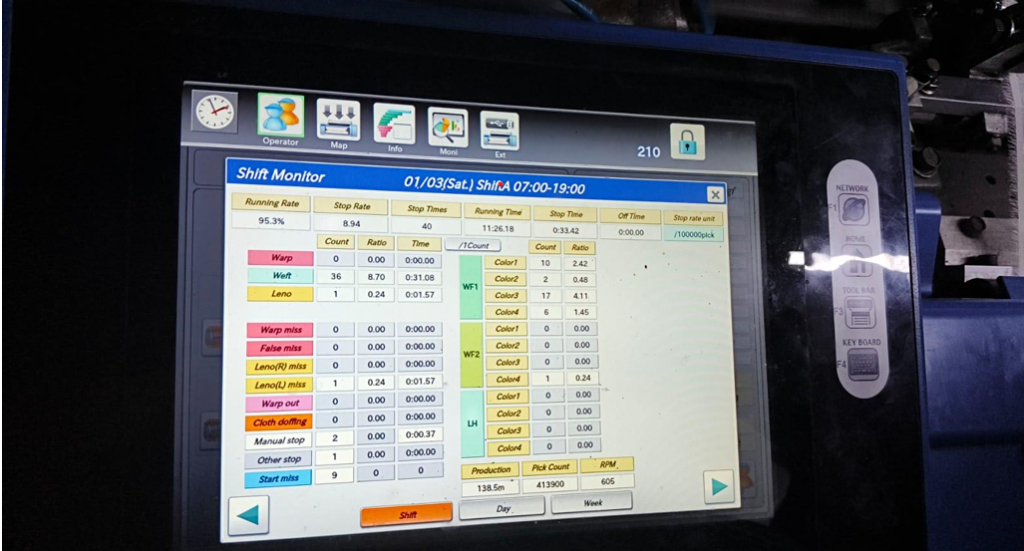
scale production conditions. The system was operated at a sustained speed of 605 RPM
with zero warp breakage, a performance level that is rarely achieved in Jacquard weaving
at such speeds.
During a single 12-hour production shift (7:00 AM to 7:00 PM), the loom achieved a total
of 413,900 picks, reflecting stable, uninterrupted operation throughout the shift. When
extended to a full 24-hour operating cycle, total production crossed 800,000 picks, placing
the installation in a significantly higher performance bracket compared to conventional
Jacquard operations.
Under normal operating conditions with traditional heald systems, comparable airjet
Jacquard installations typically achieve 335,000 to 350,000 picks in a 12-hour shift, with
frequent interruptions due to warp breakage and stability limitations. The AAS installation
therefore delivers an incremental gain of approximately 60,000–80,000 picks per 12-hour
shift, translating to around 100,000 additional picks per day
This level of output, achieved without any machine modification, highlights the impact of AAS
Tech’s component-level engineering in unlocking latent machine capacity and redefining
practical productivity limits in airjet Jacquard weaving.